Tuesday, 31 January 2012

Color Mixing Tips

An artist is one dedicate himself thoroughly in one or more activities related to art. Their art reflect their thinking or feeling. She/he could spend her/his lifetime in discovering color and the consequences of color mixing. 

Color mixing can be broadly classified into two types namely,

1. Additive – This type generally involves mixing of two light colors.
2. Subtractive - This type involves the removal of certain colors.

The following are some of the color mixing tips,

Add Dark to Light

Normally little bit of dark color is enough to lighten the colors. Any color can be faded by adding white. Consequently large amount of light color is needed to get a dark texture.

Add Solid Pigment to Transparent

Since opaque color has a far greater strength than transparent color, it is advisable to mix opaque color and the transparent one.

Stick to Single Pigments

To get an intense result for your art make sure that the colors you are using are made from one pigment.

The last tip is not to over mix the colors

Mixing of colors in a perfect ratio will add be an added flavor to your art. But don’t mix the colors until they are utterly combined. Stop mixing the colors in advance and try it down on paper or canvas to see the best result of mixing colors.

Friday, 27 January 2012

Momoyama Art

In the Momoyama period (1573-1603), a series of armed leaders, such as Oda Nobunaga, Toyotomi Hideyoshi, and Tokugawa Ieyasu, cracked to bring harmony and political firmness to Japan after the period of almost 100 years of warfare.

In response to the militaristic climate of the times two fresh forms of structural design were developed. They are the castle - a protective structure built to house a feudal lord and his soldiers in times of danger; and the shoin - a reception hall. 

The art of this period was characterized by a strong, lavish, and lively style, with gold lavishly applied to structural design, furnishings, paintings, and garments. The showily ornamented castle constructed by the daimyo for protection and to exhibit their newly obtained power demonstrated this splendor. The progress of the visual arts during this period was distinguished by the energetic patronage of two groups namely the military leadership, who brought civil strength, and the merchant class, which formed the economic backbone of the re-energized urban centers.

Momoyama Art

Thursday, 26 January 2012

Rock art

The most basic native art was paintings or engravings on rock or on the walls of rock shelters and caves. Red ochre was being used for the work of art at least 30,000 years ago in central Australia. In olden days people narrate these very old pictures to the events of Dreaming beings. In native art people used to show a continuing ancestral presence in their images which make it to look scary.

The regional styles have been reflected in three broad styles of rock art. 

The first style of can be found in Central Australia, Tasmania, the Kimberley and in the areas of Victoria. This style of art has been engraved as arithmetical figures such as circles, concentric circles, semicircles, beast paths and dots. 

The second most regional art has been found in Queensland and this is the simple figurative style of art or engraved shadows of human and animal forms. 

And the last style of regional art is of complex figurative paintings portray detailed figures, such as x-ray art that shows internal organs of humans and animals, which are particularly widespread to Arnhem Land and nearby areas.

The largest collections of rock art is found in the tradition listed Dampier Archipelago in Western Australia, in which the rock drawings are thought to number in the millions.

Rock Art

Thursday, 12 January 2012

Spanish Painting

The original Spanish paintings in the National Gallery dated from the age of the spiritually religious Ferdinand and Isabella, who controlled from 1474 until 1504, arresting sacred harmony over the diverse districts of the Iberian Peninsula as a means of achieving political supremacy. 

A famous slogan of the country’s international sightseeing crusade once stated that Spain is different. This slogan specially suits for the Spanish painters. Major painters of the 20th century include Juan Gris, Joan Miró, Salvador Dalí, and Picasso – with Picasso being extensively considered as the most inventive artist of the century.

The seventeenth century's interest in the substance world promoted a new realism in painting and saw the opening of worldly subjects such as still life and genre scenes and conquered by such masters as Juan van der Hamen y León, Francisco de Zurbarán, Bartolomé Esteban Murillo, Juan de Valdés Leal, and, above all, Diego Velázquez, the century has since been thought of as a golden age of Spanish painting.

Spanish Paintings

Tuesday, 10 January 2012

Two Award Winning Landscape Artists

Jim Laurino started the work of art at a young age, centering on marine topics under the guidance of famous marine artist Carl G. Evers. Laurino eventually developed a craze for landscape painting and for the past five years his work has been almost utterly accomplished the en-plein-air, in the open air. His common and intentional application of color generates rich and lively representational artwork. His works have appeared in numerous juried exhibits across the state and hang in private collections. 

Mara Sfara’s paintings use color and light to confine the spirit of her subject, whether it is in a portrait, still life, landscape, seascape or skyscape.

Internationally, the artist has exhibited at the Galleria de Arte Santos in Leon, Spain and at the Museo Metropolitano in Buenos Aires. Her abundant shows in the U.S. include contribution in a traveling art show supported by the Institute of Hispanic Culture, Houston, and exhibitions in museums, private and public institutions and other venues in New York, California and Connecticut. Her works are in many private and public collections as well as galleries here and abroad.

Thursday, 29 December 2011

Miniature Painting

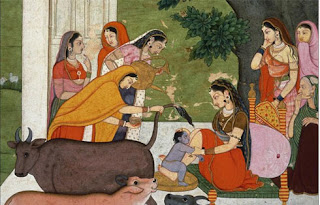
This miniature painting belongs to the Pahari style of the Himalayan foothills, a courtly style of the Raj put kings that flourished from the 17th to the 19th century.

Miniature Painting

This painting depicts the childhood days of Lord Krishna. Krishna is known in the stories of the Bhagavata-Purana as the 8th incarnation of the god Vishnu, destined to perform great deeds and remove the evils of the world. Shown in this Indian miniature watercolor painting as a child with grey-blue skin, he is a popular deity, a divine hero who personifies superhuman powers as well as human hopes and failings. Stories of Krishna's childhood with his loving foster-mother Yashoda in a village of cow-herds are much beloved and illustrated in paintings and sculpture.

Pahari Painting

Thursday, 15 December 2011

Characteristics of Oil Paintings

Those days’ oil paints require oil in order to facilitate frenzy, stable and waterproof film. Such kind of oils is known as drying oils. The other name drying oil is siccative oil. These oils are distinguished by high levels of polyunsaturated fatty acids. One of the most frequent measures for siccative or drying property of oils is the iodine amount and the number of grams of iodine captivated by one hundred grams of oil. 

Oil is said to be drying if the number of iodine is greater than 130. If the range of iodine lies in the range 115-130 then the oil is said to be semi-drying oil and those with an iodine number of less than 115 are considered to be non-drying. The most common medium for artists' oil paints is the Linseed oil (Drying oil).

We know that water gets evaporated when it is exposed to air but oil does not undergo the same. Instead of that they polymerise into a dry semisolid but the rate of process can vary depending on the oil.

The main advantage of using a slow-drying quality oil paint helps an artist to develop their painting slowly and gently. With oil-based paints an artist can improve or rework their paintings very easily. The only disadvantage with this oil painting is that it might take months or years to finish. 

Oil paints also blend well with each other, making delicate disparity of color as well as more easily generating the details of light and shadow. Oil paints can be diluted with turpentine or other tightening mediators in order to build a painting in layers, on the other hand, such agents are extremely combustible and the danger of a building fire was always present.